
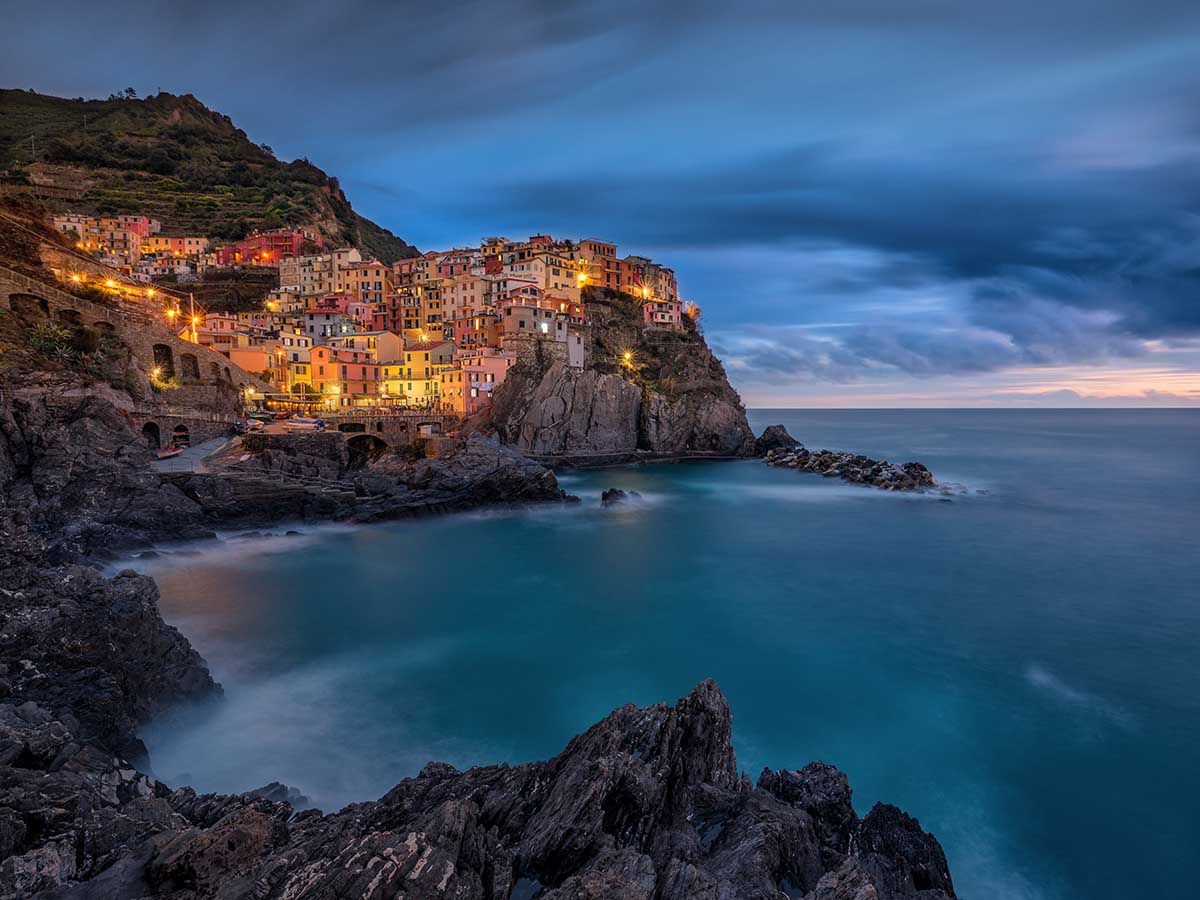
If you want to be a successful landscape photographer in Italy beyond the tourist crowds, you should take a closer look at the sights of the Ligurian coast and the hotspots Rome and Capri in November. The still very mild Mediterranean climate and the relaxed calm after the high season are particularly well suited for long-term and filter photography from a tripod. We present the impressive results of two exemplary photo short trips:
Rome and Capri – the "Eternal City" and the Evergreen Island
In the off-season, a Rollei team set out to photographically and touristically "check off" the world-famous and historically significant metropolis of Rome, as well as the enchanting island in the Gulf of Naples, all in a single weekend. If you have so little time, you should research the hotspots well in advance, prepare the most effective schedule possible, not forget the appropriate equipment - but also not lose sight of the fun and southern zest for life. In view of the pictures brought back, we believe that our team extensively considered all these aspects - this short video provides a good overview of the tight and at the same time relaxing excursion...
… the following pictures beautifully document the individual stages:

The Roman Colosseum, the largest amphitheater ever built in the world, naturally cannot be left out during a photo trip to the Eternal City. To capture its impressive architecture, even today, with an exciting cloud formation, the post- or off-season is particularly suitable. Without the usual crowds, a tripod can be set up much more relaxed and securely, even if the image, as in this case, is intended to be more decorative.


But a tripod is also best photographed at night and with a long exposure from a tripod - and the venerable St. Peter's Basilica is simply used as a secondary subject. Thanks to the very long exposure time, the street appears deserted - here, filters and remote releases worked perfectly with the Rollei Lion Rock Mark II Outdoor Tripod together:
The centuries-old stone steps, which can be found almost everywhere in the city of seven hills, provide an excellent contrast to the modern digital camera and the Lion Rock tripod of the latest Mark II generation.

After visiting Rome, we headed to the Gulf of Naples to the evergreen and world-famous island of Capri. Even without bright sunshine and tropical temperatures of the high season, the limestone island in the Tyrrhenian Sea develops its own unique charm.
To capture an extraordinary perspective, our travelers to Italy simply placed their Lion Rock Mark II into the surf – the barely visible fine rain and light wind, like the aggressive salt water, did not affect the robust and durable outdoor tripod at all.

As one of the most important changes in the Mark II generation, all new Lion Rocks feature specially shaped steel spikes that grip ice, rocks, and rough wooden surfaces at the perfect angle, allowing for such "skewed" viewing angles. Of course, the Lion Rocks also come with solid rubber feet to protect delicate floors.

Conclusion on photographing in Rome and Capri
Anyone who wants to discover world-famous sights primarily on foot pays attention to every gram - especially if they want to carry not only a camera, but also a tripod, a filter holder and the corresponding filters, as well as a selection of lenses. The very light and enormously load-bearing and robust Rollei Lion Rock Mark II tripods made of carbon are particularly suitable here. The steel spikes also ensure that no setting accidentally falls into the water, not just figuratively speaking.
Photography on the Italian Riviera
Rollei CEO Thomas Güttler, as a passionate landscape photographer and experienced globetrotter, is now quite familiar with the world. As a dedicated fan of "slow photography," he nevertheless still finds magical places that not only offer an overwhelming selection of motifs but also captivate him with their almost inexhaustible relaxation potential. After he was able to enjoy the "Arctic Silence" in the eternal ice of Spitsbergen in spring 2018, he was drawn to the Italian Riviera - to the so-called "Cinque Terre" - in November of the same year.

What does "Cinque Terre" mean?
Directly translated, "Cinque Terre" means "five lands," but actually refers "only" to five villages that cling to the rugged and steep cliffs of the Italian Riviera coast like pearls on a string at almost identical distances. Monterosso al Mare, Vernazza, Corniglia, Manarola, and Riomaggiore are the names of the five picturesque villages that, together with Porto Venere and the islands of Palmaria, Tino, and Tinetto, are a UNESCO World Heritage Site. Approximately 7,000 people live in this region - the very restrictive status as a comprehensively protected national park prevents more inhabitants from settling there. Accordingly, absolutely nothing can be changed or newly built in this approximately 12 km long coastal strip. The beneficiaries of this regulation are, on the one hand, the "locals" and nature - and on the other hand, the photographers who, of course, photograph these architectural and landscape gems millions of times each year. A special highlight is the coloring of the houses, which is particularly evident in Corniglia and Manarola. Although the tones vary within the villages, they always come together to form a harmonious and coherent overall picture. The villages also share their immediate proximity to the sea and predestine each individual "borgo" as a good-natured and at the same time extremely versatile long-exposure hotspot.
The best time to travel
 Thomas Güttler deliberately chose to visit the Cinque Terre only in November - so as not to have to decide against a village, the Rollei CEO and his wife visited all five villages, including the best perspectives for each, over four days, without getting into an unhealthy rush. After the main season, the otherwise very popular and sometimes almost "overcrowded" region slowly calms down, but nevertheless still offers latecomers or "slow" photographers like Thomas Güttler all local amenities and perspectives. The weather on the Italian Riviera is still good to the inhabitants and visitors in November, while in Germany, inhospitable temperatures, rain, snow, and/or winter storms must already be endured.
Thomas Güttler, on the other hand, traveled with his wife at more than pleasant Celsius temperatures by regional train from town to town, set up his Rollei Lion Rock Mark II tripod at the corresponding locations and enjoyed the tranquility and the results of his long exposures, while his wife relaxed with a good book.
Transport options
The railway connection of the five villages consists of a section of the "Ferrovie dello Stato Italiane" (Italian State Railways) from Pisa to Genoa, which runs almost exclusively through tunnels between the villages' own stations. Other travel and transport options are scarce; only Riomaggiore and Manarola have a connection to the road network via State Road 370, also known as "Litoranea della Cinque Terre." Only on foot, via hiking trails — including the particularly scenic "Via dell’Amore" — can one make comparatively good progress.
 Due to their unique geographical location, the Cinque Terre are spared the worst excesses of mass tourism. Package tourists, who are only looking for beaches, pools, all-inclusive drinks and round-the-clock entertainment, only get their money's worth minimally on the extremely clear sandy beach of Monterosso al Mare – otherwise the rough sea goes directly into the very rugged and steep rock formations without sandy detours.
Those who come here must explicitly have a penchant for creative interpretations of architecture and agriculture, which make the best possible use of every small horizontal surface – and be comparatively good on foot to reach the numerous viewpoints and overcome the associated differences in altitude.
Thomas Güttler positioned himself with the trained eye of a well-traveled filter and long-exposure photographer in the best spots, carefully set up his tripod, aligned it precisely using the integrated spirit levels (levels) and tried out various exposure times and filter intensities. Anyone who pursues their photographic passion in a mild climate, with outstanding subjects and without time constraints, will sooner rather than later enter a state of absolute deep relaxation.
Thomas Güttler only interrupted his exposures occasionally with a sip of good regional wine. The grapes grown in the area are also processed into their own wine varieties - "Cinque Terre" and "Cinque Terre Sciacchetrà". In fact, viticulture, along with the cultivation of olives and citrus fruits and fishing, was one of the reasons for settling this picturesque, but actually rather inaccessible, stretch of coast at all. Meanwhile, the vineyards have to be extensively supported to prevent entire slopes from sliding down.
Discovery of spectacular locations
Photographers benefit from these measures, as the numerous paths to the cultivation areas naturally allow them to discover and reach spectacular locations. However, if more or less stable railings are not largely securing the camera's position, professional photographers mainly rely on the stability and load-bearing capacity of their outdoor tripods.
The models of the Rollei Lion Rock Mark II family feature specially shaped steel spikes that can be quickly swapped out for the solid, ground-friendly rubber feet and grip at a perfect 90° angle not only in the hardest polar ice, but also in the rocky ground of the Cinque Terre, securely and vibration-free directing valuable and heavy camera equipment at the chosen subject. For the often lengthy and physically demanding ascent to the best photo spots, the Lion Rocks of the second generation are ideally suited due to their significantly reduced overall weight and the very grippy foam rubber surfaces on all three tripod legs.
Impressive shots at sunset
 Thomas Güttler specifically used the time before sunset to research suitable locations and assemble all the equipment in good time. To fully relax during a shooting in the Cinque Terre region – and at the same time achieve presentable results – not only requires a distinct freedom from vertigo.
Secure mastery of all equipment components – from the controls of the tripod, the filter holders and filters to the adjustment wheels and buttons of the camera body and lens even in complete darkness – guarantees the creation of impressive and blur-free shots that make the considerable effort and necessary walking worthwhile:

Conclusion on the photo tour to Cinque Terre
Undoubtedly, Thomas Güttler managed to combine convincing results with genuine relaxation during this short trip to the enchanting Italian Riviera. Perhaps we were also able to provide you with a suitable suggestion for your next autumn holiday? We would certainly be delighted to see the photographic results of your visit to the five sister villages of the Cinque Terre!
Share:
Time-lapse Photography: An Introduction to Spectacular Photos
Blood Moon – Photography Tips and the Process