
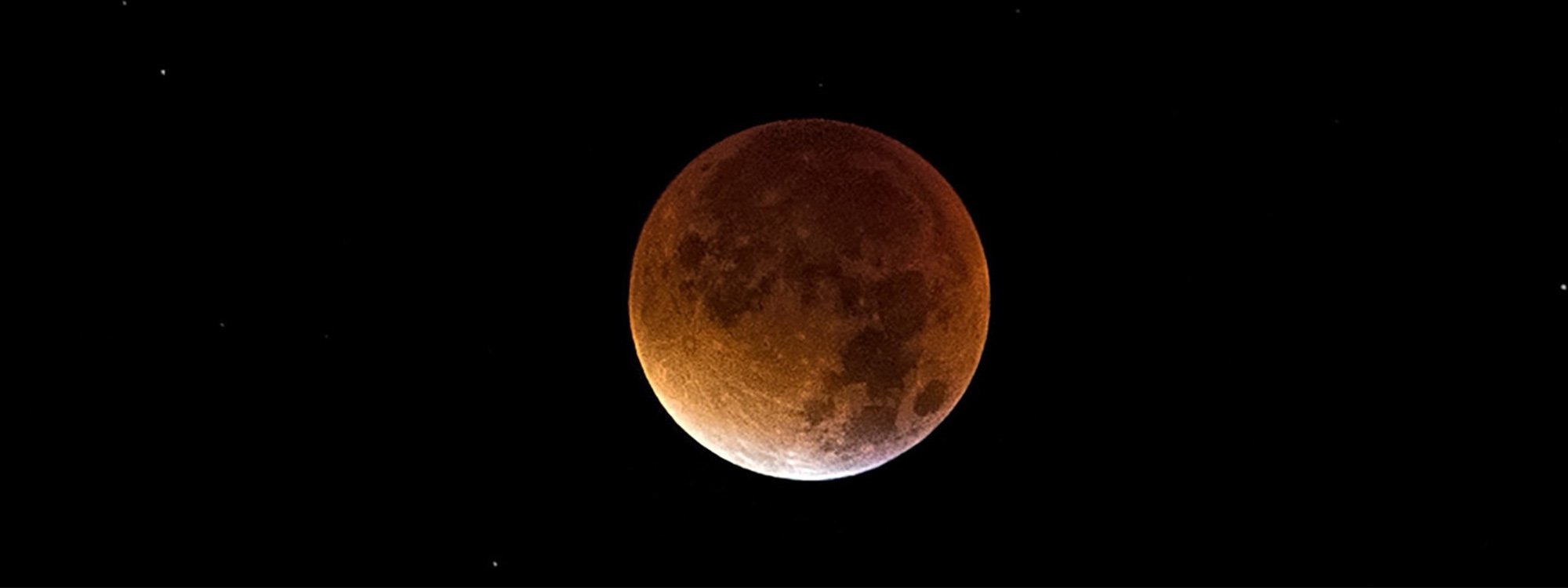
After the great success of our promotion for the last Blood Moon on 27.07.2018, we have decided to provide you with great offers around photo accessories and tips for photographing the Blood Moon again for the next total lunar eclipse on 21.01.2019. Unfortunately, the Blood Moon in January 2019 will not last as long as the last total lunar eclipse in July 2018. We will again answer all relevant questions about photographing a lunar eclipse and the sequence of events in January.
- What do I need to consider when photographing a Blood Moon or a total lunar eclipse?
- Which camera filters are useful?
- What is the timeline of the lunar eclipse in January 2019?
- What phases are there during a Blood Moon?
What is a Blood Moon?
Unlike the sun during a solar eclipse, the moon never completely darkens during a lunar eclipse. As soon as it enters the Earth's umbra, it often glows in a pale or coppery red color, which is why it is also called a Blood Moon. During a lunar eclipse, the Earth is located between the Moon and the Sun. During a Blood Moon, sunlight is refracted in the Earth's atmosphere and falls reddishly as a shadow on the Moon.

Blood Moon by Rachel Powers


Photography of the Lunar Eclipse During Totality
In the totality phase, the red sunlight refracted in the Earth's atmosphere falls as a shadow on the moon and colors it deep red, which is why it is also called a Blood Moon. Towards the edge of the umbra, the color varies from orange to yellow. While it became steadily darker as the moon moved into the penumbra and umbra, one must now absolutely consider the increase in brightness towards the edge of the umbra when photographing the Blood Moon. This leads to the edge sometimes appearing overexposed and white if pictures are taken shortly after the beginning or before the end of totality. On photos, this can have the effect that one can partially no longer distinguish between a total and a highly partial eclipse.
Particularly fast optics are recommended for photographing the moon in the umbra. An ISO sensitivity between 400 and 800 is also helpful here.
The required exposure time depends on the so-called magnitude of the eclipse, which cannot be predicted. The magnitude describes the unpredictable residual brightness of the moon in the umbra and its penetration depth. As a rule, the exposure time without an ND filter for an aperture of f/10 and ISO 400 is between three and ten seconds. However, this depends heavily on the lens used and the focal length. Because the moon moves across the sky from east to west, just like the stars. With longer exposure times, motion blur occurs relatively quickly. The higher the chosen focal length, the shorter the exposure must therefore be.
Share:
Italy in Autumn – with camera and tripod on the Riviera, in Rome, and on Capri
Photography in the Ice: 6-Day Arctic Journey