
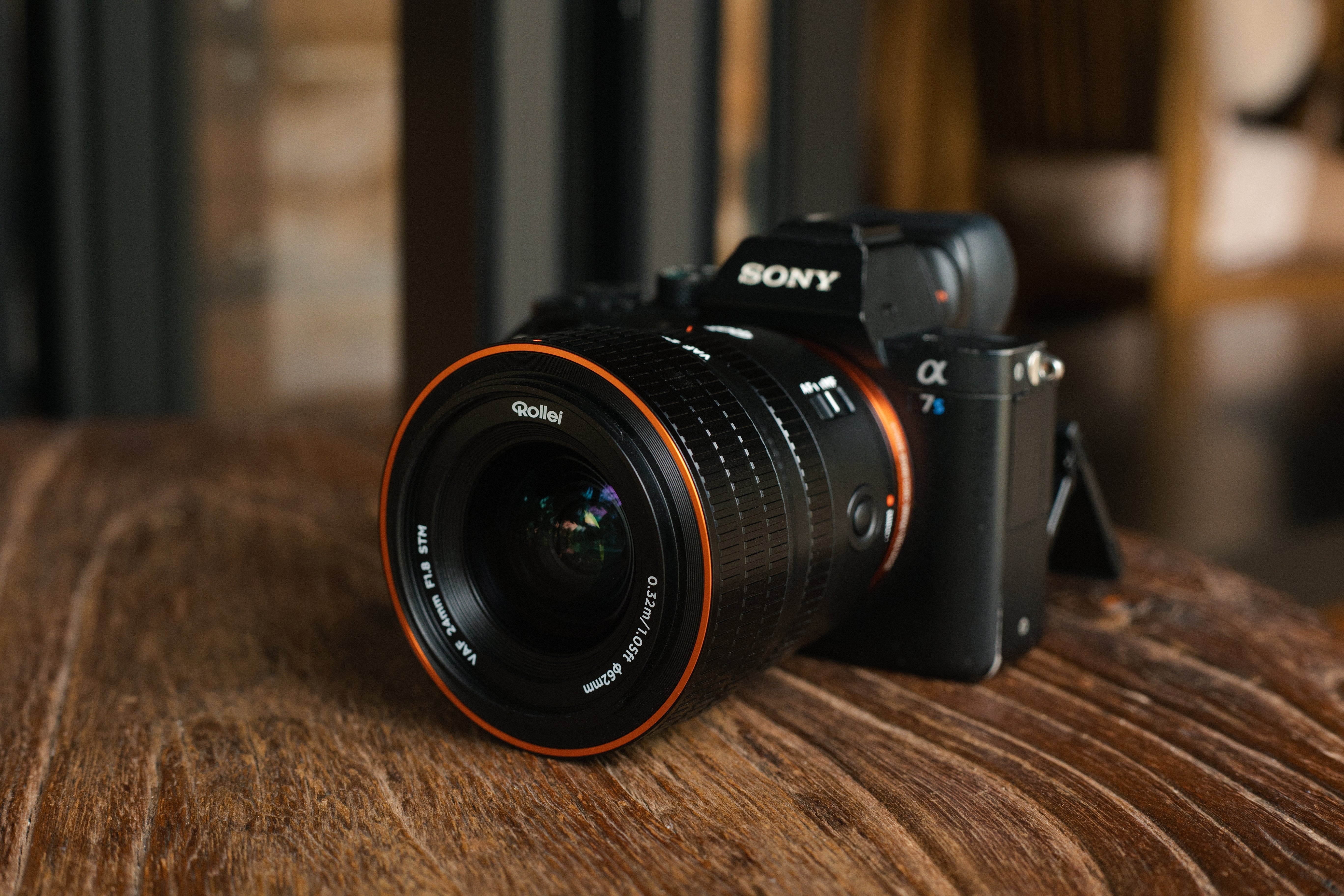
You've just bought your first camera or are considering buying a new lens. Then you've probably already come across the terms "prime lens" and "zoom lens." Maybe you've even read in forums that "real photographers" only work with prime lenses – or that zoom lenses are much more practical. And now you're confused and asking yourself: What do I actually need? Don't worry, today we'll simply explain the difference and which lens is right for you.
What's the difference anyway?
Let's start from the very beginning. You're probably already familiar with a zoom lens. That's the lens where you can turn the ring and the image gets bigger or smaller. You might know this from your kit lens that came with your camera – it says something like "18-55 mm" or "24-70 mm" on it. This means you can switch between these focal lengths without changing your position. Practical, right?
A prime lens is the exact opposite. Only one number is written on the lens, for example "35 mm" or "85 mm." And that's it. No ring to turn, no zooming in and out. If you want to get closer to your subject, you have to take a few steps forward. If you want to get more in the picture, you step back. It's that simple.

And now you're probably asking yourself, "Why should I make my life harder and do without the zoom function?" Good question – and it has more than one answer.
Why do so many people photograph with prime lenses?
When you photograph with a prime lens, you automatically learn to take better pictures. Why? Because you can't just turn the zoom ring. You have to move, try different positions, walk around the subject. And that's exactly how you train your eye for the photo. You think about: Where do I need to stand for the picture to look good? What background fits? How close do I get?
That sounds like more work at first – and it is. But it's like sports: it's strenuous at the beginning, but afterwards you're stronger than before. With prime lenses, you don't get physically stronger, but photographically better. Many photographers say that they only really learned to photograph with prime lenses.

Sharper images and that beautiful blurry background
Now it's going to get a little technical, but don't worry – we'll keep it simple. Prime lenses have a big advantage: They often produce sharper images than zoom lenses. Why? Because a zoom lens contains many more glass elements – all the lenses that move so you can zoom. With a prime lens, the construction is simpler, and you can see that in the image quality.
And then there's something else that many beginners absolutely want: that beautifully blurred background you see in professional photos. In photography, this is called "bokeh." When a person is tack sharp and the background blurs into a soft haze. That just looks professional.

This effect is primarily created by a large aperture. On lenses, you'll see a number like "F/1.8" or "F/4." The smaller this number, the larger the aperture and the more blur you can create. Prime lenses often have very large apertures like F/1.8 – and at an affordable price. With zoom lenses, a similarly large aperture quickly costs a small fortune.
This large aperture has another advantage: You can also shoot in low light without your pictures being blurry or noisy. Dinner at a restaurant? Concert with friends? No problem anymore.
But zoom lenses are much more practical, aren't they?
Absolutely right – and no one disputes that. Zoom lenses have an unbeatable advantage: They are flexible. You don't have to constantly change your position, you can quickly jump between different compositions, and you only need one lens instead of several.
Imagine you're at a concert or a sporting event. You're relatively far from the action and can't just walk to the front. In such situations, a zoom lens is perfect. This is practical if you're going on vacation and don't want to take three different lenses with you. Or if you're just starting out in photography and don't yet know exactly what you want to photograph.
While zoom lenses can't do everything perfectly, they can do a lot quite well. And sometimes "quite well" is exactly what you need. It's not about prime lenses being "better" – they're just different. And for some situations, a zoom lens is actually the better choice.
Which prime lens is right for getting started?
Which focal length should I choose? Do the numbers on the lenses mean nothing to you? No problem, we'll explain the three most popular prime lenses for beginners.
 24 mm – this is a so-called wide-angle lens. This means you get a lot in the picture. Imagine you're standing in front of a large building or in an impressive landscape – with a 24 mm, you'll capture it all. This focal length is perfect for vacation photos, landscapes, architecture, or if you're making videos of yourself (vlogging). The only disadvantage: It's not necessarily ideal for portraits, because faces can look a bit distorted, especially if you get close.
The 35 mm is something like the golden mean. It shows the world roughly as your eye sees it – not too wide, not too close. That's why photos with a 35 mm look very natural. Many photographers love this focal length because it's so versatile. You can photograph street scenes, your friends having coffee, your city at night – almost anything, actually. If you could only have one lens, the 35 mm would be the first choice for many.
And then there's the 85 mm. This is a longer focal length that allows you to stand further away and still get close. The 85 mm is the absolute classic for portraits. Why? Because it renders faces very flatteringly and because the large aperture gives you that wonderfully blurred background. If you enjoy photographing people, the 85 mm is your best choice. It's also great for details, for photos at events, or if you want to capture street scenes from a bit of a distance.
What should you buy as a beginner now?
Many photographers recommend a 35mm or an 85mm as their first prime lens. The 35mm if you like versatile photography and are looking for a lens for many situations. The 85mm if you focus on portraits and that beautiful blurry background. Both are relatively inexpensive and make a huge difference in image quality.
And the beauty of it is: You don't have to choose between "prime lens only" or "zoom only." Many photographers – even professionals – use both. The zoom lens for situations where things need to happen quickly or where you need to be flexible. And the prime lens for those moments when you can take your time and want to get the best shot.
The price makes the difference
Good zoom lenses with large apertures are really expensive. They can quickly cost 1,000 euros or more. Prime lenses with a large aperture like F/1.8 are significantly more affordable. You often get more image quality, more light sensitivity, and better results for your money.
This makes prime lenses perfect for beginners on a limited budget. For the price of a good zoom lens, you could buy two or even three prime lenses and would have better image quality in most situations. Our Rollei lenses with F/1.8 are designed precisely for this purpose: professional quality that everyone can afford.
Our tip for your start
If you decide on a prime lens, our tip is: Start with one. Take the 35mm if you want to photograph versatilely, or the 85mm if portraits are your thing. Photograph for a few weeks only with this one focal length. Force yourself to do it. It might be frustrating at first because you can't zoom. But after a few weeks, you'll notice how your eye is trained and how much better your photos become.
The decision between prime lens and zoom is not a decision between "right" and "wrong." It is a decision about how you want to learn photography and what is important to you. Both paths lead to good photos. But if you are ready to embark on the adventure of prime lenses, you will be rewarded – with better pictures, more photographic understanding, and a lot of fun.

Do you still have questions about prime lenses? Or are you unsure which focal length is right for you? Feel free to write to us at hello@rollei.de. We are happy to help you and look forward to your questions.
Share:
Panoramic shots with tripods – tips for perfect wide-angle worlds
The right focal length for every situation – 24mm, 35mm, or 85mm?