
The painter and draftsman Caspar David Friedrich is considered the most significant artist of German Early Romanticism. During his lifetime, he received both frenetic praise and fierce criticism. His works were purchased by the Prussian king and the Russian tsar, yet he died in financial hardship. His most famous oil paintings display an overwhelming and dramatized depiction of nature, though the underlying motifs rarely existed in the form depicted. Caspar David Friedrich was a master of composition and hidden messages; numerous works pursued political intentions.

The experienced photographer Harald Kröher set out with like-minded individuals to internalize and interpret Friedrich's unique visual concept. The result is a collection of very atmospheric photographs. For a photographic approach to Caspar David Friedrich, a sun-drenched beach or a scene with many people is unsuitable. Untouched nature, clouds, twilight, fog, and emptiness are the right conditions. The artist described his ostensibly misanthropic basic attitude as follows:
You call me a misanthrope,
Because I shun society.
You are mistaken,
I love it.
But not to hate mankind,
I must avoid their company.
Some phases of his life were marked by deep depression, even a longing for death. He processed his disappointments with people in his artistic engagement with nature. But now, let's leave the theory and turn to the practical results of the photo excursion. The participants, of course, had their own cameras and lenses, while the professional tripods and rectangular filters from Rollei were very popular during the expedition.

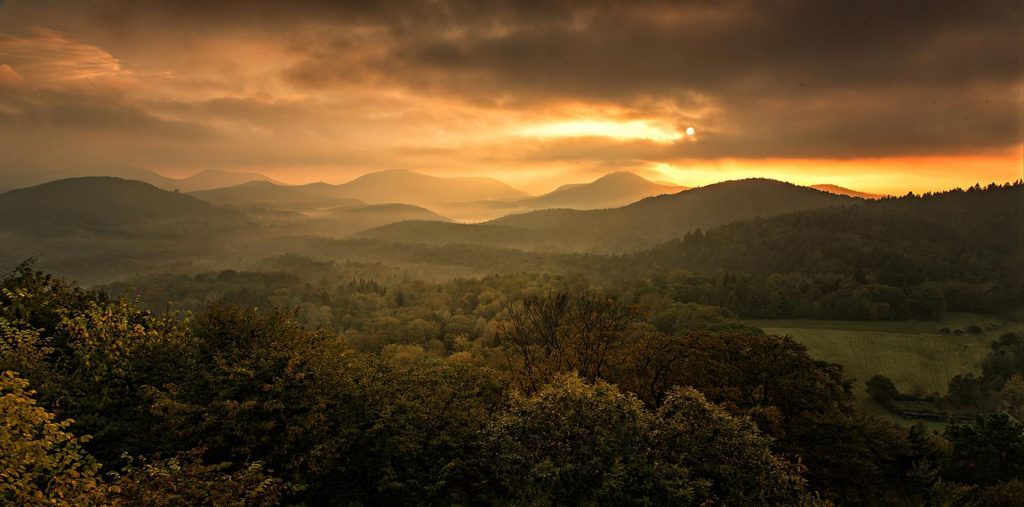
The following photo was, of course, not the first shot of the session, but it beautifully demonstrates the approach. Harald Kröher assembled his filters as follows: First, a polarizer was inserted into the Rollei rectangular filter holder. Conveniently, the holder sets already include a high-quality CPL circular filter, so that the rails for the rectangular filters can be used. Next, a soft graduated filter 0.9 was inserted from below into the first slot, then a reverse 0.9 from above to intensify the cloud layer. Additionally, Harald Kröher also mounted a 0.9 soft filter from above, to further soften the hard transition of the reverse filter and to align the visible gap precisely with the castle.

Purists might, of course, argue that this photo does not represent a true and unadulterated image of nature. However, this was not Caspar David Friedrich's claim either. Incidentally, bringing out elements and conveying a certain mood in a photo is often more challenging for a photographer than creating a pure depiction of reality. In addition to his cityscapes, which can indeed be precisely located, Friedrich's dramatic oil paintings usually have many preliminary sketches and elements. However, he composed these freely and according to his artistic needs. If people appeared in the respective works, no protagonist looked directly at the viewer; rather, the people simply let nature affect them and often turned their fictional backs to the painter. In this respect, "anything goes" if one follows in the footsteps of the romantic C. D. Friedrich; he himself, in his old age, even openly opposed the representatives of the new realism. His own creativity, a specific statement, and the free composition of motifs were more important to him than pure representational performance.

Another characteristic was the clean composition of foreground and background, exact proportions, and very often, a central perspective. The interplay of light and shadow immediately draws the viewer's gaze to the most important element of the image, while the surroundings appear almost subconsciously, creating an overwhelming impression.

Both rock images were photographed with the same filter combination. Harald Kröher considers his polarizing filters to be the crucial optical elements for the "Caspar David Friedrich look." Here, he mounted two CPLs one above the other with a distance of 3 to 5 mm; simple adapter rings are excellent as variable spacers. By rotating the upper polarizing filter, the light temperature changes from 4,000 to approx. 7,000K, creating a matte luminance typical of Caspar David Friedrich's paintings.

Attention to detail plays a very important role in C.D.F.'s work, ensuring that all pictorial motifs appear as if they could have actually existed. Therefore, a sturdy tripod is definitely used, not least when filters are to be employed. Caspar David Friedrich devoted a great deal of time and effort to careful composition, but always worked directly on the final canvas. This allowed him to bridge the gap between meticulous preparation and the vibrancy of his images. Despite depressive phases and a very melancholic underlying mood in his paintings, they never appear powerless or morbid.
Knowing that his painting "Wanderer Above the Sea of Fog" was completely fictional and precisely composed, it is surprising that very similar scenarios can actually be found and photographed. However, this also speaks to the artistic talent of both painter and photographer.

During the Napoleonic occupation, Caspar David Friedrich was particularly interested in motifs that clearly showed a national connection, such as regions or buildings. This also includes old castles or similar structures. If one comes across suitable ruins on a photo expedition, one is naturally very happy to incorporate them.

Fog, haze, or hazy visibility are perfect for the CDF look, as clearly distinguishable image planes can be identified. The distant mountain ranges appear almost composed by a painter, so harmoniously do they support the contrasts around the central image motif. It is said that Caspar David Friedrich only began with the preliminary drawings and the painting when the final motif appeared completely before his inner eye. The artist's following statement also points in this direction:
Close your bodily eye, so that you may first see your picture with your spiritual eye. Then bring to light what you have seen in the dark, so that it may react upon others from the outside inwards.
It was important to him that his paintings evoked emotions in viewers. During the time of opposition to the Napoleonic occupation, rejection of all things French was to be created and strengthened; at other times, he was also concerned with the majestic effect of nature, whose drama he was certainly allowed to stage himself. For a photographic approach, therefore, situations or moods may well be exaggerated.

On the other hand, it should also be remembered that Caspar David Friedrich's imagery has been misused by nationalists and adapted by Hollywood directors for tragedies, war films, and science fiction movies. Indeed, many motifs now appear unrealistic due to this conditioning, even though they were in no way manipulated and were seen with one's own eyes.

However, the photographers around Harald Kröher exclusively enjoyed the picturesque motifs that they could capture from strategically advantageous positions during the excursion. Tips and tricks were exchanged, new techniques and perspectives were learned. Especially photography with filters requires a structured approach when the possibilities of the optics are playfully explored. Many filter effects are difficult or impossible to change or remove afterwards, so one should always work with exposure bracketing for complex challenges. Otherwise, one regrets missed opportunities and lighting moods. The exact position of the sun constitutes the special charm of this image; a few seconds before or after, completely contrary lighting situations can be found. Here, not only technical expertise but also a good gut feeling is required, which usually stems from years of experience.


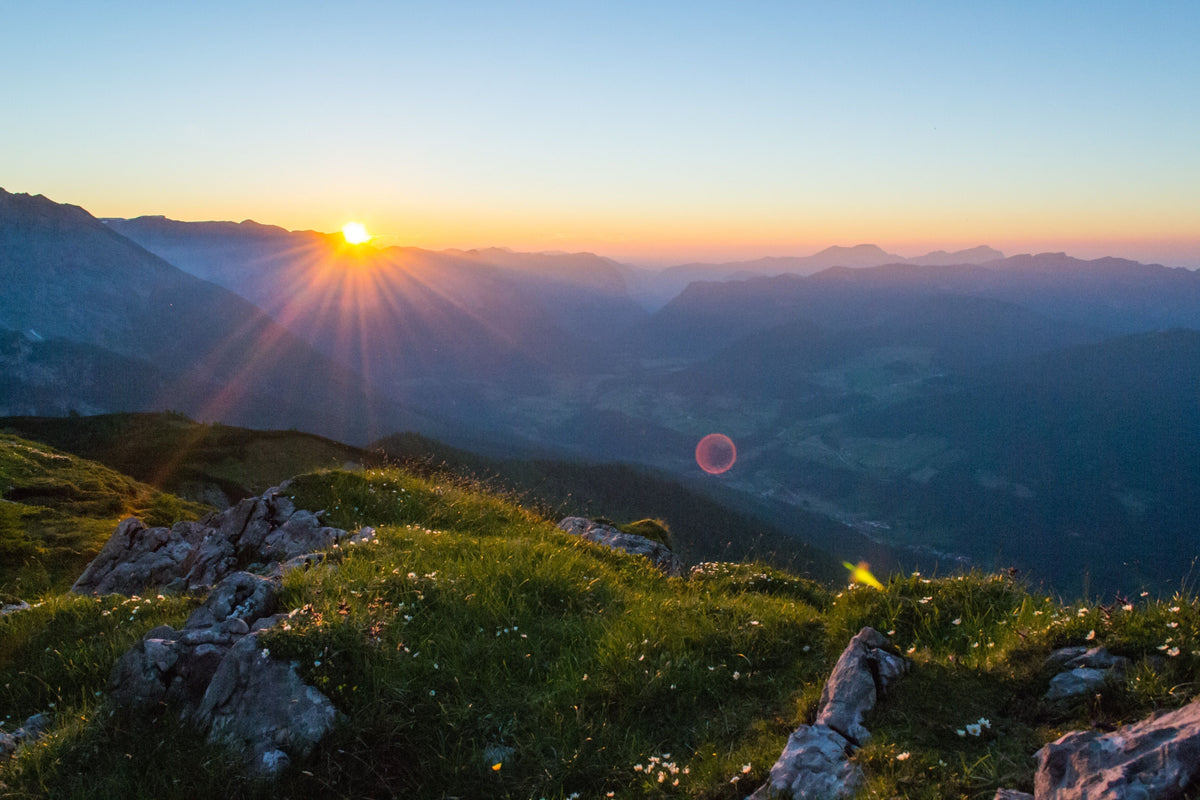
The indirect depiction of sunbeams through various haze layers and the impression of a suction effect towards the center of the image clearly show more CDF influences on the composition. This is intensified by the bright, almost luminous tips of the vegetation in the foreground.

This image also primarily thrives on correct timing, both regarding the sun's position and the prevailing light conditions. This photo could easily have "sunk" into darkness.

The combination of the very softly rendered water with the high-contrast and detailed depiction of the overgrown rock also qualifies this image as a result inspired by Caspar David Friedrich.

Only a slight long exposure is needed to give this spectacular perspective a clear and very bright focal point. The very linear composition picks up on the existing vanishing lines and skillfully plays with the viewer's expectations.

It's a pity that a couple of small airplane contrails pin this image to our time. Otherwise, the two towers and the wonderfully washed-out rocks in the foreground would also make a suitable scene for a future "Lord of the Rings" film adaptation. Peter Jackson's sets often resemble the atmospheres of Caspar David Friedrich.

With this extraordinary misty atmosphere, we conclude our excursion into the pictorial worlds of Caspar David Friedrich. The renaissance of his artistic legacy continues to inspire painters, draftsmen, and of course, photographers, more than 170 years after his death.

Share:
Product Photography: 8 Tips for Modern Product Photos
Tripod made of Carbon or Aluminum – Differences & Recommendations