
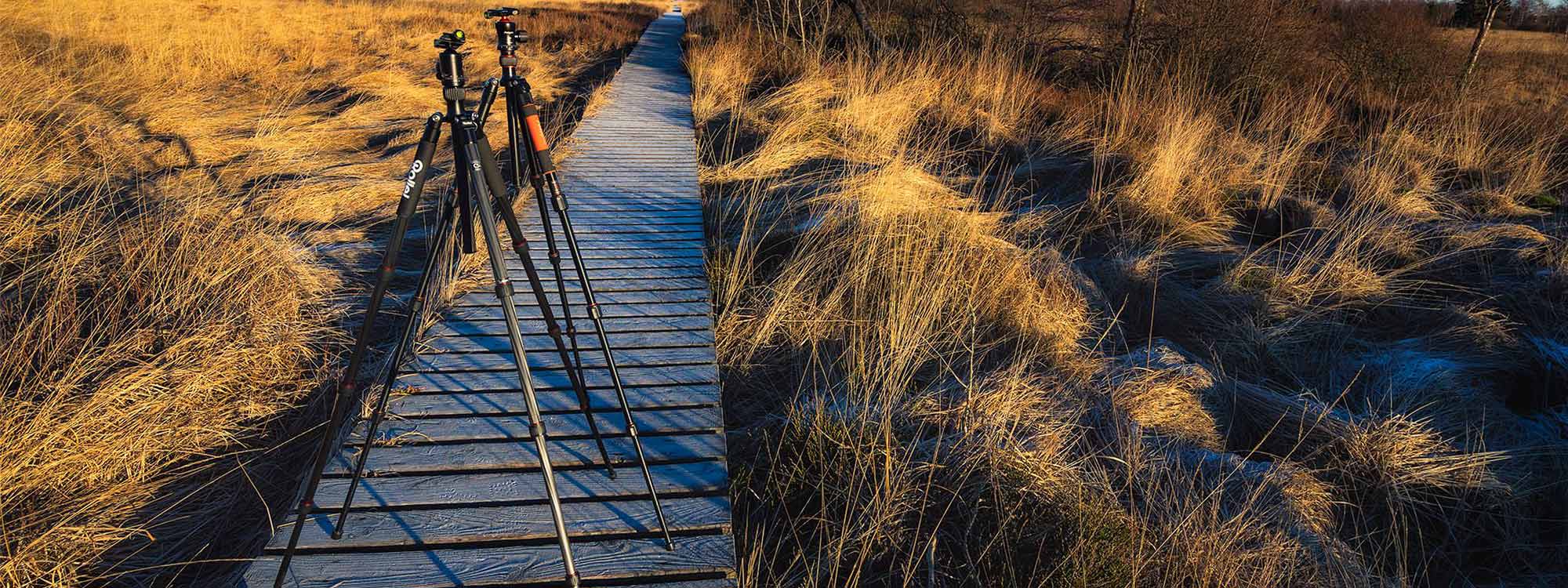
Almost every photographer needs a tripod, and since it is usually a very durable product, it is
even more important to make the best possible choice right away. The decision already starts
with the material, because both carbon and aluminum have different advantages and
disadvantages that you should know before making your purchase decision.
The simple answer to the question of the right material could be that a beginner should first get
the cheaper aluminum version and an advanced photographer should rather buy the more
expensive carbon tripod. However, in my opinion, it is not that obvious, because neither of the two
materials is always better, and they are simply different.
To have the best possible comparison of these two variants, I bought the exact same tripod in
both aluminum and carbon. I have been using the former for my photos for years and now I want
to know if a change of material and the associated extra cost are really worth it.
The two test tripods are the following aluminum & carbon tripods:
Both versions already include a ball head (which is, of course, "Arca Swiss" compatible) and are
almost identical in size with 44 cm when retracted and a maximum extended height of around
160 cm. The aluminum version has a maximum load capacity of 10 kg, while the carbon version
still holds 8 kg.
Tripod weight of Aluminum & Carbon
In addition to stability, weight is, of course, one of the most important features, because a tripod is
only useful if you have it with you. So, this is a very good reason to make sure you carry as little
weight as possible, otherwise you would often find yourself thinking about just leaving it at home.
However, this factor has a different value for everyone, as it mainly depends on the type of
photography.
A portrait photographer in a photo studio might not be particularly bothered by a heavier tripod,
but a travel photographer undoubtedly benefits from less weight on their shoulders when they are
on the go all day and want to have all their equipment with them. Therefore, it strongly depends
on how long you walk to the places you want to photograph.
In Iceland, for example, a lightweight solution was not as important as I initially thought, as large
parts of the journey often have to be covered by car anyway. Therefore, it also strongly depends
on how much you ultimately want to hike, because in some cases more weight can even be better.
The reason for this is, for example, the stormy weather on the island or the strong current of many
rivers. In both situations, more weight can also provide more stability.
Aluminum: 1.91 kg
Carbon: 1.34 kg

Our advice:
If weight is important to you, then a carbon tripod is definitely the better choice.
Almost 600 grams may sound insignificant at first, but the difference if you have to carry this
weight on your shoulders all day is enormous. About a year ago, I replaced my camera with a
lighter, mirrorless one, which saved me about 500 g, and that alone was an unexpectedly big
change for me. In big cities like New York, I was often on my feet for up to 14 hours a day, with
all my equipment on my back.
However, going back to the accommodation to get the camera equipment in time for sunset is
usually not worth it just because of the travel time. After a few days, this resulted in shoulder
pain for me, which is why I started leaving my tripod at home on some days, and often these
were exactly the days when I needed it most. As I said at the beginning, your equipment is only
useful if you have it with you.
So, if you travel a lot on foot, you should undoubtedly opt for a carbon tripod.
Material properties of Aluminum & Carbon
When it comes to the material itself, there are 3 particularly important properties that you should
consider when making your purchase decision.
1. Corrosion
Carbon is very weather-resistant and even resistant to corrosion, for example, when used in
saltwater. Aluminum tripods are usually protected by an additional layer. However, scratches or
other damage to the material can lead to corrosion if the aluminum is then used in damp
conditions.
2. Vibration reduction / vibration absorption
Every seller of carbon fiber tripods will point out that vibration absorption is significantly better
than with aluminum. For me personally, however, this is more of a nice side effect than a truly
relevant advantage. The reason for this is that there are some other and often better ways to
stabilize your tripod:
- Use a remote release to avoid shaking yourself when you press the camera's shutter button.
- Focus and shoot using your camera's display and not through the viewfinder, because for this, the mirror must already be flipped up when you start your exposure (this, of course, does not apply to mirrorless cameras).
- Attach something heavy to the hook of your tripod (most modern tripods have such an attachment option, so you should also pay attention to this when buying) to further improve stability. Therefore, keep in mind that vibrations cannot always be best reduced by more expensive equipment. This also applies to shots you take in a river, because here too, an aluminum tripod with significantly more weight can be advantageous, regardless of whether carbon has better vibration damping or not.
3. Temperatures
What many people don't know is that a damaged carbon fiber tripod behaves quite differently than
an aluminum one. The big difference between the two materials is that aluminum first bends and
then eventually breaks. Carbon, on the other hand, is not elastic and breaks immediately after a
certain bend. Therefore, it can happen, for example, that even minor impacts on aluminum are
noticeable in the form of scratches or dents, whereas carbon can withstand this undamaged.
Nevertheless, carbon tends to be more susceptible to extremely cold temperatures. So, if you are
photographing the Northern Lights all night in extremely cold conditions, you should definitely make
sure that you do not hit the tripod against hard objects, as the material is significantly more prone
to breakage under these circumstances. Such extreme situations probably do not apply to most
tripod owners, and yet, in my opinion, it is important to at least keep such a property in mind.
On the other hand, you prefer carbon in such cold weather, as the material does not feel as cold
on your hands as aluminum does. Since many tripods already have rubberized legs for exactly this
reason, this factor should not influence your decision too much.
Our advice:
As you can see, there is no clear winner in this section when it comes to the advantages of material
properties. They are simply different and behave differently in different situations. I would probably
give the carbon tripod a small advantage, but ultimately it depends very much on what type of
photography you are interested in and what properties are important to you.

Pricing of Aluminum & Carbon Tripods
The price range of tripods available on the market is quite wide, but this depends not only on the
material, but also on the different sizes, quality, purpose, and of course, the brand.
As a rule, carbon tripods are significantly more expensive, because advanced photographers, as
the target group for this type of tripod, demand not only better material but also overall better
workmanship. Even if the difference for the two Rollei tripods is not so great, the carbon version
still feels a bit more valuable, which may also be due to the fact that it is a newer product from the
company.
Our advice:
You will most likely not buy a new tripod every year, as the technical standard of tripods does not
change as much as electronic products. Therefore, in my experience, it is even more important to
buy a good and sturdy tripod right away, instead of investing this money in many cheaper
alternatives, which you will usually quickly realize that you should have bought a decent version
right away. From this perspective, it is often even cheaper to choose the right tripod right away.
However, if you are just starting your photography career and are not yet sure whether you will
stick with this hobby, you might want to start with the cheaper aluminum version and possibly
upgrade later.
Final words – Advantages of Carbon & Aluminum Tripods
As you have seen, there are some differences between the two materials compared. To give you
concrete decision-making aid, I would decide on the respective tripod version based on the
following circumstances or criteria:
Carbon: If you travel a lot, hike, or are often in larger cities, this usually means that you will cover
a lot of distances on foot. In this case, weight is the most important factor, because a tripod can
only be useful if you actually have it with you. Therefore, I would definitely recommend the carbon
version for this case, as it offers the best combination of weight and stability. If you also want to
pay attention to the price, the C-5i Carbon is recommended, which is already offered at a very
affordable price including a ball head.
Advantages of Carbon Tripods:
- High-tech material – robust and ultra-light at the same time, like our City Traveler carbon travel tripods
- Stronger than steel and lighter than aluminum
- Good and reliable bending and torsional stiffness
- High breaking and tensile strength
- Dimensional stability at high heat and cold
- Low dead weight and therefore ideal as a travel tripod
- at least equivalent stability to aluminum tripods
Carbon Tripod Test Reports 2017:
- Rollei Lion Rock 25 Mark II in review
- Rock Solid Carbon Tripods practical test
Aluminum: If you have just discovered photography, if you generally rarely need a tripod due to
the type of photography you do, or if you primarily photograph in the studio or at home, then this
material is definitely a very good choice for you. Especially if you are looking for a very stable
tripod at an affordable price, you should prefer this material.
Advantages of Aluminum Tripods:
- light, stable and robust
- cheaper than carbon tripods and ideal for beginners
- high strength
- optimal damping of vibrations
- excellent price/performance ratio
Ultimately, however, you can't go wrong with either material, as long as you follow the following
additional tips when choosing a tripod.
Additional tips
No matter which brand or material you prefer, please make sure that you do not buy the cheapest
tripod available on the market. I have seen so many people on my travels who have mounted their
exorbitantly expensive equipment on a €20 tripod. If your camera gets damaged just because you
saved a few euros on your tripod, then in the end you haven't gained anything at all.

Please don't do that!
The same applies to overall quality, as a tripod is definitely not just a tripod. I have tried out a lot
and also started with a very cheap version, where it was a real pain to adjust the camera's
alignment. It literally ruined so many chances and pictures for me because I simply lacked the
options. Often, I even left it completely at home due to the weight.
For everything you do in life, there are so-called opportunity costs. This means that if you
experience perhaps the most breathtaking sunset of your life in New York and you don't have the
opportunity to capture it well photographically, then you won't get that chance again so quickly
and easily. It would cost you an enormous amount of money to fly to New York again and again to
possibly get that chance again. Exactly for this reason, I have now decided against saving a few
euros when choosing my equipment, when the trips to the places I want to photograph cost me
many times more.

These Gorillapods or Monkeypods initially seem like a good interim solution, as they are very small
or light and yet, according to the manufacturer, have a high load capacity. There are definitely
situations where they represent a real alternative, but the situations where you will curse this type
of tripod are clearly in the majority. A good example of this is Manarola in Italy, where there is a railing
to which you can attach this tripod. The problem, however, is that all other tourists will constantly
shake this railing, even if there is no obvious reason for it. I therefore had to shoot my photo
freehand with high ISO, as it was absolutely impossible for me with this tripod at sunset, even
though I invested over €100 in this version.
For example, I pay €70 every time I fill up my car's tank, and every time I can't take the desired
photo at a photo spot because of my equipment, I might as well have saved the time, the trip, and
the associated costs. Therefore, I can only warmly recommend that you choose a tripod that suits
you directly. I personally can highly recommend a tripod from the Rollei C5i series, as I have
been using them myself for years due to their excellent price-performance ratio – and I am not
even paid by Rollei for this statement. In my opinion, both tripods are simply a very good choice,
as you get very good quality for little money. Of course, there is always something better, but the
question everyone has to ask themselves is whether they really need this "something."



Share:
Wanderer Above the Sea of Fog: Compositions After Caspar David Friedrich
Creative Photos with the Rollei HS Freeze 6: A Review by Johannes Krebs