
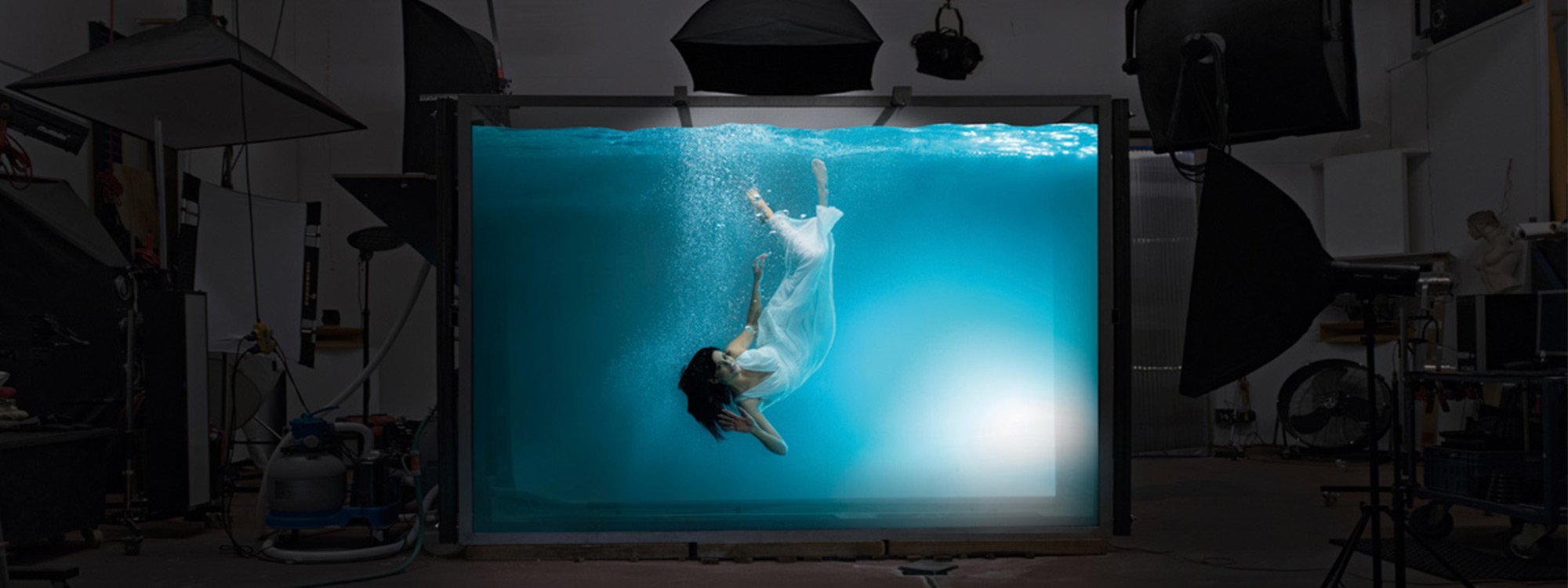
Underwater photography requires not only special (and usually very expensive) equipment, but also comprehensive expert know-how and many years of experience. Photo professional Manfred Zentsch has now found a way, with a lot of ingenuity and patience, to professionally implement even seemingly impossible image ideas directly in the studio with comparatively little time and expense. He opened his studio for an exclusive workshop for six curious readers of FOTOHITS magazine...
Manufacturers of swimwear, water sports, and diving articles naturally want to present their latest creations in the element for which they were developed – in the water.
However, professional underwater photo shoots could not simply be realized "just like that" in the stormwater retention basin on the outskirts of the city. Public swimming pools are increasingly reluctant to respond to photographers' requests – which is absolutely understandable given the great effort and the now seamlessly merging occupancy of swimming and water sports clubs.
The expensive alternative solution: relocating to the tropics or the Caribbean for warm, bright, and calm seawater. Given ever-dwindling marketing budgets, this option represents the worst-case scenario for internal company controllers.
The Photographer Manfred Zentsch
Heidelberg-based professional photographer Manfred Zentsch has now found a cost- and time-saving alternative. With astonishing experimental enthusiasm, much patience, and despite numerous setbacks, he finally succeeded in installing a water tank in his studio that solves a variety of previous photography problems in an extremely clever way. The results of his in-house underwater shoots impress even seasoned diving and photo professionals.
FOTOHITS magazine convinced the experienced advertising and architectural photographer to hold a one-day workshop for interested readers. Rollei was also present, as the mobile HS Freeze 6 battery-powered studio flashes played a significant role in the successful implementation of the unusual setting idea.

The Very Special Studio
The experienced photo professional set up his studio on the premises of the former Heidelberg slaughterhouse – the hall of the former teaching butchery serves as a suitable setting for his extraordinary water tank. Anyone working with 9 cubic meters of water and 2 cm thick, 700 kg special glass panes cannot, understandably, set up shop in a "normal" office floor or their own garage.
The building of the former teaching butchery still has a very efficient drainage infrastructure – which Manfred Zentsch unwittingly had to use during the construction of the 1.0 version of the tank: within ten minutes, the artificial basin completely drained and also flooded the remaining studio rooms on the ground floor.
In the second attempt, the skilled photographer was able to directly apply the experience gained and comprehensively reinforce the original basic construction at the critical points. By now, only a few drops of water escape the tank at certain spots. According to the Heidelberg photographer, he can live perfectly well with this result – he abandoned the idea of 100% watertightness relatively early on.
The Water Tank
To be able to move the tank when needed, Manfred Zentsch specifically bought a used forklift. Nevertheless, only the empty shell can be moved. Without water, the tank weighs "only" around 2 tons; filled with 9 cubic meters of water, it weighs about 11 to 12 tons. The side panels consist of professionally welded steel, and the special glass panes were developed and manufactured by the GLAS-MAYER GRUPPE. The bottom of the underwater photo basin consists of 3 cm thick wooden ship planks to allow easy installation of inlets and valves.
The special highlight, however, is the background projection. Manfred Zentsch equipped a commercially available, 6,500 lumen bright LCD projector with a wide-angle and a special shift lens to be able to "play" any desired motif onto a cove behind the tank with largely distortion-free results from a precisely defined position close to the ground.
The photo professional had to solve numerous challenges to finally combine the camera position, the size and depth of the water tank, and the background into a harmonious whole.
Thanks to the very elaborate tinkering, Manfred Zentsch can now create the perfect underwater illusion – even at second glance, his pictures don't reveal that they were not taken in the endless expanses of an ocean, but that only a 70 cm wide water wall "deceives" the viewer's perception.

The Lighting
Three Rollei HS Freeze 6 professional studio flashes, precisely positioned above, in front of, and behind the tank, provide the right light.
These flash units, highly praised by the trade press, were predestined for this very demanding application due to three characteristics: Firstly, the three HS Freeze models can be easily triggered absolutely synchronously via a radio transmitter and – depending on the camera model used – in creative flash modes such as HSS, Freeze, and Stroboscope mode, completely unproblematically from the desired distance.
Secondly, the HS Freeze 6 take less than a second to provide full luminosity again after being triggered – absolutely indispensable for model shoots, as even the most experienced freedivers cannot stay underwater indefinitely and can only use a very limited range of motion – here, photographers must "keep shooting" in continuous shooting mode.
The third characteristic, however, is truly vital: Since even with extremely careful preparation, it can never be completely ruled out that water might get onto the flash units due to an unlucky coincidence or careless movement of the model, mains-powered devices with 220 volts are not allowed for safety reasons.
The batteries of the Rollei professional flashes provide approximately 500 flashes even in continuous shooting mode.

The Schedule
Professional photographer Manfred Zentsch had a rather strict "timetable" in store for the six participants: After a brief introduction to the technical background of his solution (which you could already learn about in the first part of this blog series), four rounds were planned – model Katherina was to slip into four different costumes and handle several accessories in front of changing background motifs.
The six participants (five men and one woman) then mounted their cameras with Arca-Swiss quick release plates onto the Rollei Rock Solid tripod, placed at a fixed distance and low height. They then plugged the radio transmitter for the HS Freeze 6 into the hot shoe and could then direct the model as desired – and also select the respective background.
Since the distance to the subject (7 meters) was precisely fixed (the model could only move within a 70 cm wide area, the horizontal and vertical dimensions of the tank were also precisely "marked out" in the camera's viewfinder), the respective photographers manually focused their lenses, chose an aperture of f/8, and then worked with an effective focal length of approx. 80 mm.
This could, however, vary in some cases, as one or another "dry" underwater photographer worked with a lens adapter.

The First Motif: Mermaid
The exposure time was only between 1/60s and 1/80s, as the two or three HS Freeze 6 provided sufficient brightness for the subject. The background was deliberately kept slightly out of focus to create the illusion of spatial depth – the described focal length-aperture combination is the result of numerous test series that Manfred Zentsch carried out beforehand.
For the first round, model Katherina (a certified Level 2 freediver, after all) donned a very decorative mermaid costume and then stoically followed the photographers' instructions. They had previously been divided into "camera brand groups" to avoid constantly having to reconfigure the radio transmitters and receivers. In the first round, Sony owners were allowed to start, followed by Nikon owners, then the Canon enthusiasts. Subsequently, the sequence changed several times.
A challenge for the participants, who understandably had no comparable experience before, was finding the right combination of individual camera options – Manfred Zentsch's personal recommendation was the slow continuous shooting mode and completely manual focusing – but some participants found that their cameras (especially in Live View mode) had problems capturing the model's movements satisfactorily.
However, in the course of the afternoon (the workshop was scheduled from 11 am to 5 pm), all attendees found the perfect settings and procedures for themselves and their cameras.
As a background, the participants predominantly chose between an underwater scenario created by Manfred Zentsch himself and a rather striking potpourri of air bubbles.

The Second Motif: Evening Gown
The second costume Katherina had packed in her "mermaid" suitcase for the workshop – the immensely photogenic model has, by the way, been running her own very successful "Mermaid School" for some time now – was a bright red evening gown.
In contrast to the mermaid costume, which was undoubtedly better adapted to underwater use, Katherina had to make significantly more effort to suppress the unruly behavior of the flowing fabric in the photographers' interest. However, they had already become somewhat familiar with the unfamiliar conditions in the first round and increased the flash frequency accordingly to capture the unique moments.
As a background, Manfred Zentsch alternated between a very abstract and geometric motif and the already proven "bubbles."
The photographer used his two apprentices to operate the bubble pump – two pipes with numerous holes, attached to the inside bottom of the tank and supplied with air by a compressor.

The Third Motif: Tunnel Construction Site
For the third "episode," Katherina jumped into the water in a bikini, slipped on an orange high-visibility vest, and took a massive pickaxe in her hand. The purpose of this costume became clear to the participants through the display of a historical tunnel construction site.
With graceful – and, given the fragile glass, very controlled – movements, the water-loving Katherina then posed for the photographers.
They repeatedly expressed their unreserved admiration for the black-haired freediver – although the water had been preheated to approx. 23 degrees before the workshop, even the experienced mermaid suffered from the inevitable body heat loss as the hours passed.
The Fourth Motif: Backlight Shoot
For the fourth shooting series, the model took two strips of fabric into the tank – to give the participants the opportunity to use a third Rollei HS Freeze 6 as a backlight flash. This round was accompanied by a very special atmosphere, as studio owner Manfred Zentsch extinguished most of the light in the room after each camera and photographer change.
The silhouettes of the surrounding participants, the triple stroboscopic light of the Rollei flash heads, and the graceful movements of the underwater model combined to create an enormously atmospheric "flow." At the end of the backlight shoot, Manfred Zentsch then handed each participant his own Sony again to allow for handheld close-ups.
After an incredibly varied and instructive practical session, Katherina finally climbed out of the tank after the last flash trigger, to the loud applause of those who had stayed dry, and wrapped herself in her warming bathrobe.
To anticipate: none of the participants planned to build their own underwater shooting tank immediately after returning home. The decisions to book this truly unique workshop in Heidelberg stemmed from completely different motivations.
A large portion of those present only learned about the indoor underwater studio from the trade magazine FOTOHITS and were, on the one hand, simply curious about what obstacles professional photographer Manfred Zentsch had to overcome to realize his long-held dream – on the other hand, they also promised themselves an inspiring change from their "normal" photo practice and also wanted to find out what results they would achieve in the quite demanding live shoot in the studio with their own cameras.
After the various rounds with changing tasks, however, all participants were without exception enthusiastic about the process and their results – and also admired the perseverance and equanimity of the underwater model Katharina.
Between the sessions and, of course, after the practical part, there were numerous opportunities to exchange ideas – and to give and receive expert feedback.
All participants became more and more routine and proactive during the workshop, from session to session. While the photographers present were initially very busy finding and trying out the right camera settings, even in the final shoot, which took place almost in complete darkness, setting up for readiness took significantly less time and feedback from Manfred Zentsch.
Directing the model, who, of course, could only audibly perceive instructions during the relatively short "breathing phase," also became clearer and quicker with increasing practice.

Participants' Opinions
The participants enthusiastically used the breaks between their turns to take behind-the-scenes photos – and to increasingly exploit the potential of the Rollei radio remotes for the three HS Freeze 6 studio flashes during the shoot.
Before the post-production phase, which then took place on the upper floor of Manfred Zentsch's Indigo Studio, the participants had time and leisure to review the past few hours – which, according to unanimous opinion, flew by far too quickly. While the studio owner loaded the contents of all memory cards onto his central hard drive for subsequent viewing, statements such as "This was already worth it" and "Great inspiration and thinking outside the box" could be heard.
Some attendees were also happy to finally be able to try out functions of their camera "live and in color" that had not yet been adequately utilized. Furthermore, the photographers, who primarily focus on portraits, wanted to learn more about the mobile and powerful Rollei HS Freeze professional studio flashes – and, of course, about the various tripod families.

Post-Processing
Once all the photos – many participants had taken several hundred pictures – were on Manfred Zentsch's editing server, the necessary post-production was exemplified. The focus was not on alienation or the addition of effects.
Due to the optical conditions and technical restrictions, some measures were on the to-do list that simply cannot be ignored with this very special setup in order to take home satisfactory results:
Color Correction
Since Manfred Zentsch used real glass for the construction of the water tank, the slight green tint of the otherwise highly transparent material had to be compensated. This minimal coloration could only have been significantly reduced by using considerably more expensive and thicker plexiglass. However, since this green cast is relatively easy to correct, the professional photographer understandably refrained from unnecessary additional costs.
Optical Distortion
Due to its molecular structure, water causes a refraction of light rays that deviates from the ray path in "normal" air. The 70 cm wide water tank acts like an oversized magnifying glass – and therefore also requires appropriate correction.
Contrast and Sharpness
Due to the movement of the model and the optical characteristics of the tank, it is advisable to work with manual focus and a depth of field that roughly corresponds to the width of the tank. If certain areas of the motif are to recede more into the background or be given more contrast, corresponding readjustments are of course also necessary.
Soft Focus
Model Katharina wisely only used the two very decorative fabric panels towards the end of the shooting. Natural textiles continuously lose material – and of course also "lint" under water. The lint gradually clouds the water more and more and ensures that the flash light is reflected by millions of tiny suspended particles. To counteract this process, a slight soft focus of "affected" regions is recommended.
Background in a New Layer
The background projection then naturally also fades a little due to the water turbidity – here, photographer Manfred Zentsch partially places the respective background image as a new layer in the image editing program over the motif, deletes it here and there, or adjusts the transparency.

The Conclusion
The six hours of Manfred Zentsch's UW studio workshop actually flew by – but left all participants with numerous new insights and exciting inspirations.
Those who weren't behind the camera also had many opportunities to exchange ideas with the experienced studio owner and the other participants.
The diverse impressions of this Saturday in Heidelberg will likely remain in memory for a long time and have a lasting impact on the daily photographic practice of those present.

Share:
Photos in the Snow: Photo shoot in a Swiss ice cave
Learn Macro Photography: The Complete Guide for a Quick Start