
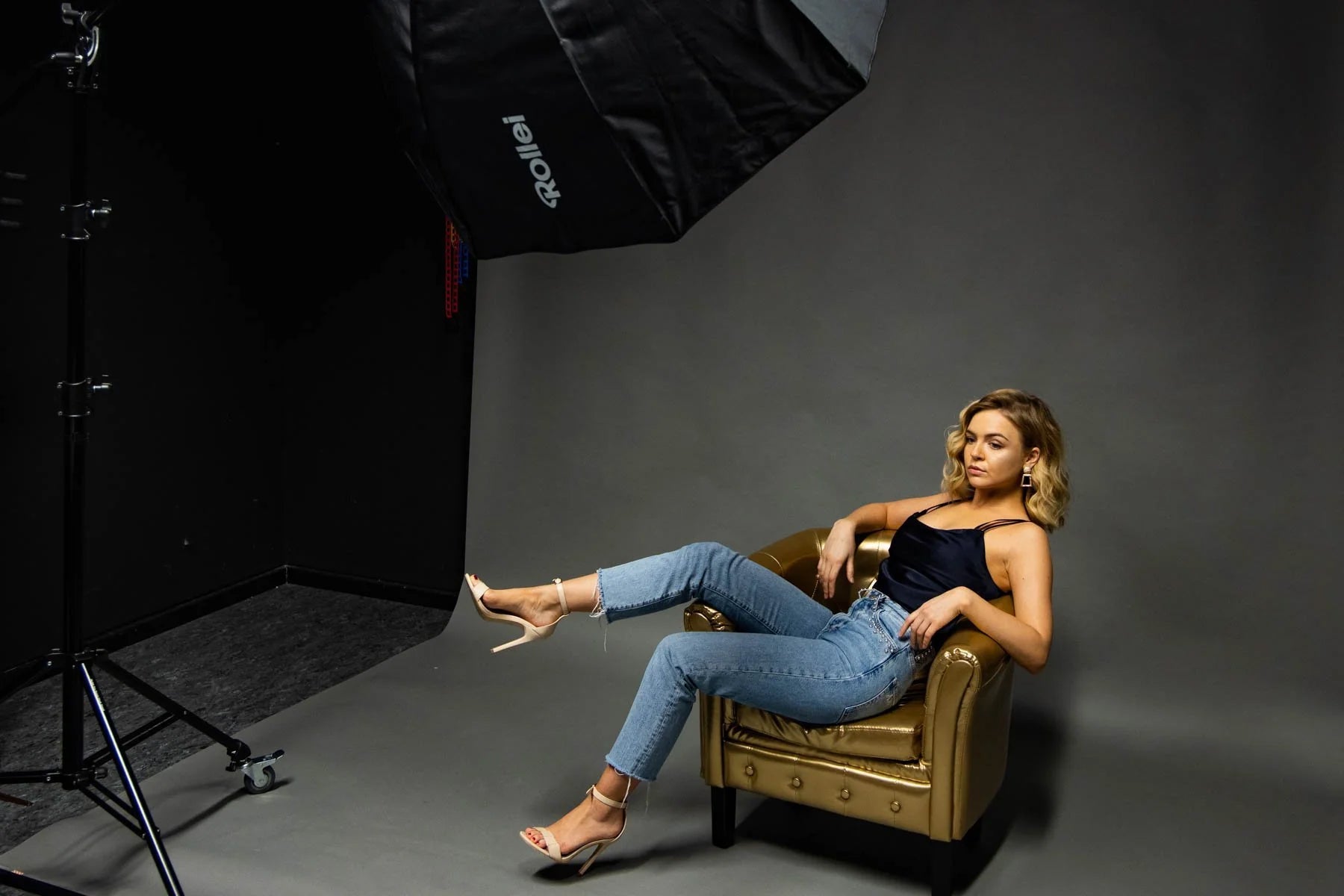
Light shapers are indispensable when shooting with flash. It is only through them that one is able to effectively direct the light where it should be. But what types of light shapers are there and what accessories should one have? And are there mistakes one can make when buying them? Ten questions for professional photographer Harald Kröher.
1. What is a light shaper?
2. For what scenarios do you need light shapers?
3. What types of light shapers are there and what light shapers do you need for what purpose?
4. What should you pay particular attention to when buying?
5. What accessories should you have for a basic studio setup?
6. What are the most common beginner mistakes when working with light shapers?
7. What would be the basis of exposure, for example?
8. So, and now a few valuable insider tips from the pro.
9. What are the general advantages of individual light shapers?
10. What quality differences are there in flashes?

1. What is a light shaper?
A light shaper is an attachment for flash or continuous light that directs the light onto the subject to be photographed. If, for example, with flash heads there was no way to direct the light, then there would be no focusing and it would be completely disordered - diffuse. It would therefore spread out in all directions.
Shapers offer the possibility to direct the light where we want it. It can be focused, but also made almost diffuse, or even used very precisely, almost punctually.
In summary, one can say: without light shapers there is no photography with flash technology.
2. For what scenarios do you need light shapers?
Actually, in studio photography, there is no scenario in which you don't use light shapers. If you can't direct the light, studio photography fails. That's why you need light shapers in all variations.
Among photographers, there's a humorous saying: "Only photographers who can't flash use available light."
The art is to flash in such a way that it doesn't look like you "shot" the subject. The aesthetic for the eye only arises when the light is directed.
No light shapers without flash, no flash without light shapers.
3. What types of light shapers are there and what light shapers do you need for what purpose?
There are various types of light shapers. However, the different variants can be reduced to:
- Softboxes with inner and outer diffuser and honeycomb grid
- Stripes (also called striplights) are basically also softboxes, which create their own hardness due to their construction
- Standard reflectors, which are available in various designs and with various inserts, e.g., the snoot (tube) and
- The Beauty Dish
What does a Beauty Dish do? The name "dish" already suggests the shape of the Beauty Dish. It is a very wide-angle, shallow reflector whose opening is covered by a small baffle: the metallic Beauty Dishes are very good for portraits in the studio. However, if you travel a lot, they should be foldable, which is, for example, an advantage of Rollei products.
It is important that a honeycomb grid is included and that the coating is not perforated.
It's also a fact that the light from a softbox can sometimes appear too flat for a portrait. However, with Rollei's foldable Beauty Dish, you can work very well.
Reflector umbrellas are basically nothing more than rain or sun umbrellas with a reflective (white or silver coated) inner surface, which are mounted backwards, i.e. with the opening facing backwards, in front of the light source - so that the flash shoots directly into the umbrella. The subject is then placed in front of the opening of the reflector umbrella, so that the light reflected by the umbrella is directed onto the subject.

4. What should you pay particular attention to when buying?
Very important: the price-performance ratio must be right. Therefore, you should consider what you need the respective accessory for.
If you only shoot in the studio, you can also use the "salad bowl" (metallic Beauty Dish). If you travel a lot, the accessories must be quick and easy to fold.
Overall, light shapers should be easily transportable (own carrying bag), robust and weatherproof, with easy mounting (bayonet mount, e.g. Bowens) on the flash head even in adverse temperatures. It would also be desirable if a diffuser for inside and outside, a stripe and a grid were available in one package.
Stands should be spring-loaded, easily lockable, robust and easy to transport; you should also check the weather resistance of stands and light shapers beforehand. A large softbox also has a large surface area for wind and weather. In windy conditions, you should therefore use very simple standard reflectors if necessary, as they have only a small surface area.
5. What accessories should you have for a basic studio setup?
For the basic equipment, I always advocate for three flash heads. This way, you can easily build a basic set that is completely variable and versatile:
- Frontal light (e.g., Beauty Dish), looped and with butterfly setting on the person's face. Loved by Marilyn Monroe, through whom the Beauty Dish became really famous (eye reflection is round like the pupil) and looped means approx. 30 degrees to the side
- Parabolic or Stripe (striplight) from the other side perpendicular to the model
- Headlight with standard reflector, (shaded, background is black and can be lit with a fourth head if needed)
With this set-up, you can play with the light. The main light (Beauty Dish) should ideally be two f-stops brighter than the side light with the stripe or vice versa. Always with the question of what the photo should express. The head or contour light placed behind the model is also variable and depends on the model's hair color and skin type.

6. What are the most common beginner mistakes when working with light shapers?
A major mistake is that the light is not aligned correctly. This means that the head light does not fall on the hair, but above it or on the back of the neck.
Tip: Before shooting, the photographer should stand next to the model and check if the light is directed at the head.
Otherwise, you might shoot an entire set and only then realize that the lighting is wrong. It's important to learn the basics of flash photography, including how to use a light meter. Adult education centers offer basic courses that you should definitely attend.
Otherwise, for me, it would be like learning to write without knowing the alphabet.
7. What would be the basis of exposure, for example?
For example, knowing the five different lighting setups in portrait photography .
- Butterfly Light, also Paramount Light: This lighting setup was particularly popular in 1930s Hollywood. The light is positioned centrally above the model's head at an angle of 25° to 70° and creates a distinctive, butterfly-shaped shadow under the nose.
- Split Light:One side of the face is directly lit, the other shadowed. The light is at a 90° angle to the model. This light is very dramatic.
- Loop: A small shadow of the nose falls on the model's cheek, but does not touch the shadow of the cheek. This setup is used very often. For this, the light must fall from slightly above the model's eye line towards the corner of the mouth. It is similar to the Butterfly Light above the model's head, but slightly shifted to the right or left (between 20° and 50°).
- Rembrandt: The namesake Rembrandt often used this light for his paintings. It is similarly dramatic to Split. The main light is above the model's head, but strongly shifted to the side. A striking triangle of light is created on the shaded cheek of the face pointing towards the camera.
- Broad Light: Similar light position as with the Rembrandt Light, however, the model's face is turned away from the light. Thus, the strongly lit side of the face points towards the camera and the light triangle on the cheek is on the side turned away.
8. So, and now a few valuable insider tips from the pro.
Before buying inferior goods, it's better to wait a bit and then get something high quality. For example, the Freeze 6 with various light shapers, which can be used universally. It always impresses me in all situations, not just with its common menu navigation and extreme robustness. Such a flash head with light shapers is of course not a purchase for one year, but should still be sufficient even when demands have grown, because they change very often over time.
Gradually, you can then expand your equipment, depending on what you want to photograph.
9. What are the general advantages of individual light shapers?
The advantage of a reflector umbrella is, for example, that it emits very homogeneous, soft light that appears gold, silver or simply bright, depending on the coating of the inside. It is also cheaper than a softbox – it costs about a quarter of the price. Small umbrellas can also be used very well outdoors. A very big advantage here is the easy transport.
If possible, you can use umbrellas for nudes and portraits. But I would not use just a flash head and an umbrella alone; I always need hard light, for example a stripe from the side as a contour light or an additional head light with a standard reflector placed offset behind the model.
This creates depth in the photo and, as photographers say, the image doesn't look flat.

10. What quality differences are there in flashes?
There are significant quality differences. State-of-the-art technology is only possible with state-of-the-art flash heads. I would therefore never buy a flash (especially for outdoor photography) that cannot work with HSS technology. If it cannot flash on the second curtain, it's simply not good. Because showing movement is a primary concern in photography.
If these basic techniques are not available, I don't need to buy modern flash heads. It is also crucial today that flashes are battery-powered. It must, of course, have a certain amount of power and not need to be changed after only 100 shots. Of course, this is always very temperature-dependent.
I always say: What good is a flash head that only has a cable connection, when I rarely have an outlet on the beach?
Share:
3 Methods for Impressive High-Speed Photography
Photographing with an ND filter: 12 tips for waterfall photos